Biological farming is often criticised for working only in trials or small demonstration blocks. The real question is whether it holds up on a commercial farm, year after year, under normal farming pressure.
This farm decided to test that properly. Instead of opinions, it relied on soil testing, careful monitoring, and conservative fertiliser decisions. Two soil tests from the same paddock (P8), taken in September 2022 and again in October 2024, tell a clear story about what happens when soil biology is allowed to do its job.
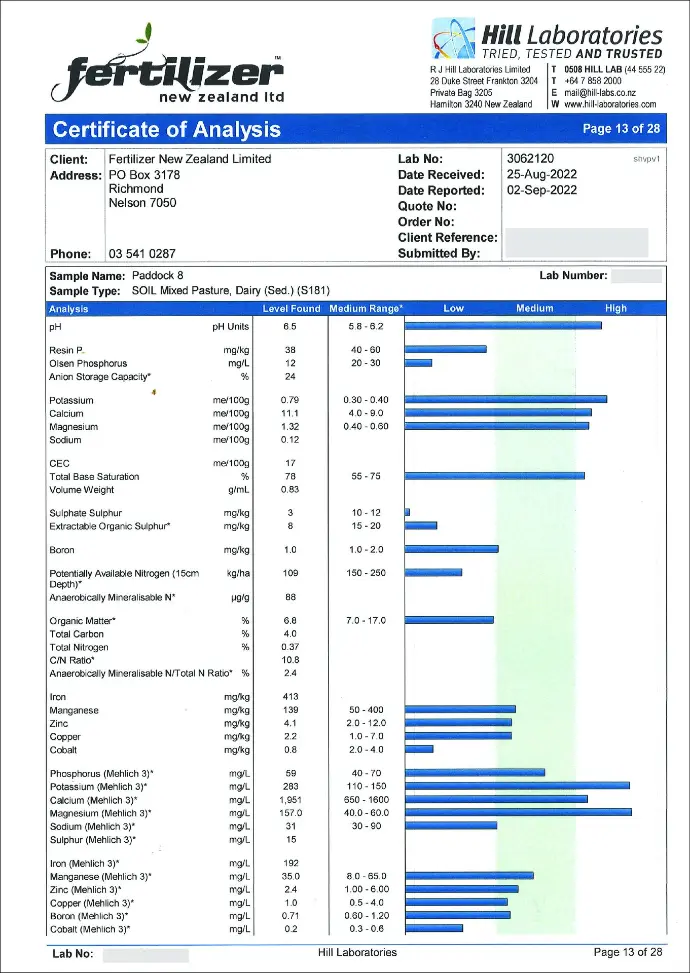
2022 Soil Test
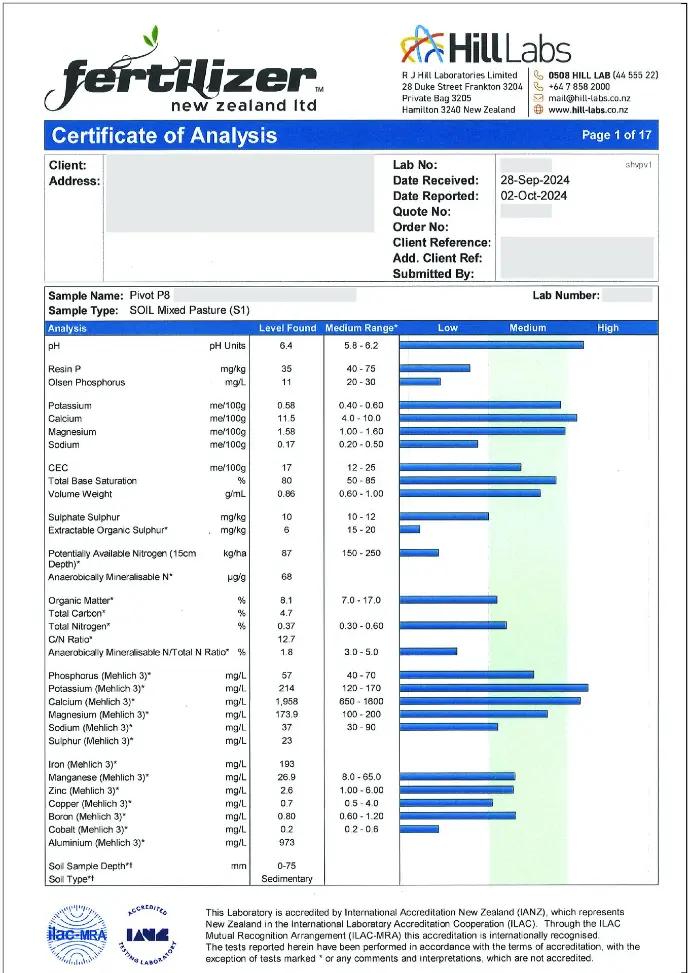
2024 Soil Test
Starting From a Solid Base
The 2022 soil test showed a soil already in good working order.
Soil pH was 6.5, ideal for nutrient availability and microbial activity. The cation exchange capacity (CEC) of 17 me/100g indicated a soil with a strong ability to hold nutrients. Base saturation sat at 78%, suggesting the soil was reasonably well balanced.
Calcium dominated the exchange sites at 66%, supporting good soil structure. Magnesium at 7.7% was in a healthy range. Organic matter measured 6.8%, with total carbon at 4% — a solid platform, but with room to improve.
Phosphorus levels were moderate rather than excessive. Resin P measured 38, and Olsen P was 12. With an anion storage capacity (ASC) of 24%, the soil had a good ability to retain phosphorus and make it available through biological cycling.
Nitrogen indicators also looked positive. Potentially available nitrogen was 109 kg/ha, supported by anaerobically mineralisable nitrogen (AMN) of 88 µg/g. A carbon-to-nitrogen ratio of 10.8 suggested nitrogen would mineralise readily.
One result stood out. Potassium was already high at 0.70 me/100g. Based on this, no potassium fertiliser was applied.
Two Years Later: Stability With Improvement
When the paddock was tested again in October 2024, the most important result was not dramatic change — it was consistency.
Soil pH remained stable at 6.4, and CEC stayed at 17 me/100g. Base saturation increased slightly to 80%, showing a gradual improvement in nutrient balance.
Calcium remained steady at 66%, while magnesium increased to 9.1%, often linked to better aggregation and moisture retention. Bulk density increased slightly from 0.83 to 0.86 g/mL, still well within an excellent range for pasture soils.
One of the clearest gains was in organic matter. It increased from 6.8% to 8.1%, while total carbon rose from 4% to 4.7%. These are meaningful changes, reflecting better soil structure, improved water-holding capacity, and greater biological resilience.
Letting Biology Do the Work
Phosphorus levels barely moved. Resin P slipped slightly from 38 to 35, and Olsen P from 12 to 11. In practical terms, availability was maintained, confirming effective biological cycling.
Sulphur availability improved where plants need it most. Sulphate sulphur increased from 3 to 10 mg/kg, while extractable organic sulphur declined slightly. This indicates organic sulphur was being mineralised into plant-available forms.
Nitrogen behaviour also shifted in a positive direction. Potentially available nitrogen reduced from 109 to 87 kg/ha, and AMN from 88 to 68 µg/g. At the same time, the C:N ratio widened to 12.7, suggesting nitrogen was being released more slowly and in better alignment with pasture demand.
The Potassium Result That Matters
Despite applying no potassium fertiliser, soil potassium moderated naturally. Levels fell from 0.70 to 0.58 me/100g — still adequate, but better balanced.
This is an important lesson. Excess potassium can interfere with magnesium and calcium uptake and contribute to animal health issues. By trusting the soil test and avoiding unnecessary inputs, the system corrected itself.
Why This Matters on Real Farms
This farm is not chasing ideology. It is focused on function, stability, and repeatability.
Over two years, the soil has:
- Increased organic matter and carbon
- Maintained phosphorus availability
- Improved sulphur cycling
- Smoothed nitrogen release
- Avoided unnecessary fertiliser inputs
Most importantly, it has done so without volatility. Nutrients were not mined, nor were they forced. The soil was managed as a living system.
These two soil tests show that biological farming, when guided by data and discipline, can improve soil condition while maintaining control. Not in theory. On a real farm, at real scale.
Stability not spikes without excess Nitrogen