The Foundation Beneath Our Feet
When people look across a farm, they usually see grass, crops or animals. Rarely do they stop and think about what lies beneath the surface. Yet soil is one of the most complex and important living systems on Earth.
Healthy soil is far more than dirt. It is a living structure made up of minerals, water, air, organic matter and billions of living organisms working together in balance. Every productive farm, healthy ecosystem and strong food system depends on this balance. Understanding the various aspects of soil is becoming increasingly important as farmers face pressure around productivity, environmental protection and long-term sustainability.
Soil Types - The Physical Foundation
Every soil begins with its physical structure. In New Zealand, soils vary enormously depending on climate, parent material, rainfall, volcanic activity and land use history. The main soil types include clay, loam, sand, peat, silt, pumice and mixed soils.
Most farms contain a combination of several soil types rather than a single uniform soil. A farm may have clay loams, sandy loams or peaty silts across different paddocks. Understanding these differences is essential because each soil behaves differently under grazing, cultivation, irrigation and fertiliser use.
Clay Soils
Clay soils contain very fine particles that pack tightly together. These soils often hold nutrients well because of their high cation exchange capacity, but they can become compacted and poorly drained if overworked.
Clay soils:
- Hold water strongly
- Retain nutrients well
- Can become waterlogged
- Are prone to pugging
- Can become hard when dry
If managed carefully, clay soils can be extremely productive. However, soil structure is critical because once compacted they lose air spaces needed for root and microbial activity.
Loam Soils
Loam soils are often considered the ideal agricultural soil because they contain a balanced mixture of sand, silt and clay. Many of New Zealand’s most productive cropping and mixed farming regions are based on loam soils.
Good loam soils:
- Drain reasonably well
- Hold nutrients effectively
- Maintain air spaces
- Support strong root growth
- Are easier to cultivate
Peat Soils
Peat soils are rich in partially decomposed organic matter. They are often dark in colour and can hold very high amounts of water. When healthy, peat soils are some of the largest natural carbon stores in the landscape.
Peat soils:
- Are naturally high in carbon
- Hold moisture well
- Can shrink or subside when drained
- Often require careful nutrient management
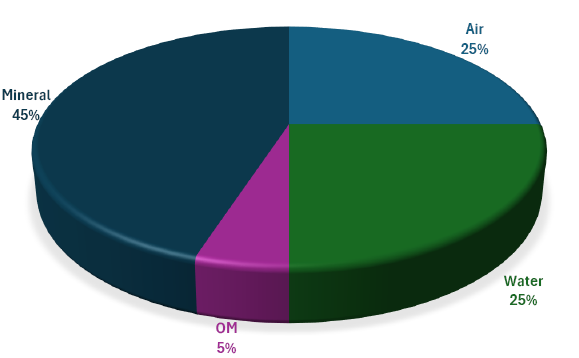
Earth, Air, Water, Mineral & Organic Matter
Air in the Soil - The Forgotten Requirement
One of the least understood aspects of soil is that healthy soil must breathe. Good soil contains thousands of tiny pores filled with air. These air spaces are essential because plant roots and soil microbes both require oxygen to survive. Without oxygen, biological activity slows dramatically.
Anything that damages soil structure or results in high water tables or excessive surface water will rob the soil of air. Poor soil aeration can result from both intentional and unintentional actions or activities. Things like heavy machinery use and cultivation can cause compaction, while water logging means there all the spaces are filled with water. When soils lose air:
- Roots struggle to grow
- Beneficial microbes decline
- Anaerobic organisms increase
- Nutrient cycling slows
- Toxic compounds may develop
This is why soil structure is so important. A well-structured soil acts almost like a sponge and holds both water and air at the same time.
Water in the Soil - Life’s Transport System
Water is another essential component of healthy soil. Water in the soil is like blood in humans. It transports nutrients and regulates temperature. It also supports microbial activity, maintains plant growth and drives biological processes.
Different soils hold water differently. Clay soils may hold large amounts of water but drain slowly, while sandy soils drain rapidly and struggle to retain moisture. The challenge for farmers is not simply getting water into the soil but keeping it there while maintaining enough air space for biology to function.
Healthy soils with strong organic matter levels are far better at retaining moisture during dry periods. This becomes increasingly important as droughts and weather extremes become more common.
The Unsung Hero - Soil Organic Matter
While minerals, water and air are critical, there is one part of the soil that often receives far too little attention: soil organic matter. In many productive agricultural soils, organic matter makes up around 5% of the soil. Yet this small fraction has an enormous influence over everything else. Without organic matter, soils begin to lose structure and function. That 5% acts like the glue holding the entire soil system together.
Soil organic matter is made up of decomposing plant material, microbes, fungi, organic residues and other carbon compounds. This organic fraction helps:
- Bind soil particles together
- Improve soil structure
- Increase water holding capacity
- Store nutrients
- Feed microbial life
- Reduce erosion
- Improve resilience
Carbon is the backbone of soil organic matter. For decades, farming systems focused heavily on nitrogen, phosphorus and potassium. But increasingly, scientists and farmers are recognising that carbon is equally important because it drives biological activity and soil function.
Healthy carbon levels also help create stable soil aggregates. This is the crumb-like structure that allows soils to hold both air and water simultaneously. When soils lose carbon through excessive cultivation, erosion or poor management, they often become harder, tighter and less biologically active.
The Hidden Workforce - Microbes and Fungi
Living within this organic matter is an underground world of biology that most people never see. Billions of microbes and kilometres of fungal networks can exist beneath a single square metre of healthy pasture. These microbes include bacteria, fungi, protozoa and nematodes. It also includes invertebrates such as earthworms and arthropods. These organisms perform essential jobs:
- Breaking down organic matter
- Cycling nutrients
- Fixing nitrogen
- Building soil structure
- Protecting plant roots
- Retaining nutrients
- Forming stable carbon compounds
Fungi are particularly important because fungal hyphae physically bind soil particles together, improving structure and water infiltration. Mycorrhizal fungi also form partnerships with plant roots, helping plants access nutrients and moisture.
Bacteria play equally vital roles in nutrient cycling and decomposition. Species such as Rhizobium, Azotobacter and Bacillus are increasingly recognised for their contribution to healthy soils and plant growth.
People’s perception of soil is changing from just being a growing medium to being a living ecosystem.
The Future of Soil Management
Modern agriculture is beginning to shift toward farming systems that protect and rebuild soil function rather than simply feeding crops directly with soluble nutrients.
Healthy soils are dynamic, biological systems
- Minerals provide the framework
- Water provides transport
- Air supports respiration
- Organic matter provides energy
- Microbes and fungi drive the engine
When all these parts work together, soils become more productive, resilient and environmentally stable.
The future of sustainable farming may depend not only on what is added to the soil, but on how well the entire living soil system is managed. Because beneath every productive pasture and crop lies an extraordinary living world. One that quietly supports food production, water quality, climate resilience and life itself.
Start writing here...
The Living Soil